Author: Wayne
Greenhaw
James E. Chrisp, ...
spent one session as a student in Searcy College
Abstract from Sharp Co., AR
Record Newspaper
Robert
Edward Lee Saner Julian Ashby Burruss #1 #2
From the book "Searcy, Arkansas: A Frontier Town Grows Up With
America"
by Raymond Lee Muncy 1975
Located in the White County Library
page 111-115
In 1883 W. H. Tharp, from Fayette County, TN and a graduate of
the Macon Masonic College, moved to Searcy
and opened the Searcy Male and Female College, the town's first attempt at coed higher
education. The building which housed the school was located first on the corner of Center
and Pine Streets. With the assistance of John W. Conger, who
later became the first president of Ouachita Baptist College, Tharp secured the services
of some of the best teachers in the area. The campus consisted of several buildings which
were Searcy landmarks for many years. The former Carl Dodd house was the administration
building. A two story girl's dormitory was moved to the corner of Gum and West Pleasure
Streets where it later served many years as a rooming house. The houses of W. E. Davis and
Cecil Lammers were constructed of materials from the house west of the administration
building that was once used for piano practice. West of this building a double log house
with a dogtrot served as the primary department, later the location of the P. A. Robertson
house.
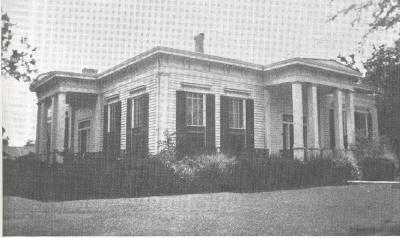
The old Searcy College built at the end of the Civil
War. Also served as the Dudley Gill and Woods Hotel, the William Watkins house, and Sue
Lee's boarding house, photographed in 1937. Courtesy of Richard Hill
The old Searcy College built at the end of the Civil War. Also
served as the Dudley Gill and Woods Hotel, the Williom Watkins house, and Sue Lee's
boarding house, photographed in 1937. Courtesy of Richard Hill.
In 1883 W. H. Tharp. t'rom Fayette County. Tennessee.
and a graduate of the Macon Masonic College. moved to Searcy and opened the Searcy Male
and Female College. the town's first attempt at coed higher education. The building which
housed the school was located first on the corner of Center and Pine Streets. With the
assistance of John W. Conger. who later became the first president ofOuachita Baptist
College. Tharp secured the services of some of the best teachers in the area. The campus
consisted of several buildings which were Searcy landmarks tor many years. The former Carl
Dodd house was the ad- ministration building. A two story girl's dormitory was moved to
the corner of Gum and West Pleasure Streets where it later served many years as a rooming
house. The houses of W. E. Davis and Cecil Lammers were constructed of materials from the
house west of the administration building that was once used for piano practice. West of
this building a double log house with a dogtrot served as the primary department, later
the location of the P. A. Robertson house.

P.A. Robertson house on the corner of Center and Elm Streets located
where the
Townhouse Apartments are now. Courtesy of Neil Cope
The Searcy College Catalogue, 1886-1887,
boasted of two large buildings, well ventilated, one for the college proper and one for
the boarding of young ladies, "located on the most beautiful building site in town,
convenient to the Square, and yet sufficiently removed to avoid the noise and bustle of
business." The administration building had two fronts and separate "play
grounds," one for the ladies and one for the young men. The sexes were never mingled
except under the strict supervision of the teachers. Everything was reported to be done
"decently and in order," yet without "the police force system."
Although the Searcy College maintained high religious and ethical principles, it was not
sectarian. College exercises began each day with chapel services. which all students were
required to attend on the threat of expulsion from school. Orderliness was the watchword,
and Professor Tharp insisted that everything and every person had a place and should be
kept in it. The curriculum consisted of Latin, Greek, moral philosophy, mental philosophy,
natural philosophy, familiar science, physiology, political economy. chemistry, rhetoric.
trigonometry. algebra. professive grammar. geography. Roman and American history, reading
and dictionary. Calisthenics for the ladies was included, military tactics for the men,
and freehand drawing for everybody.

Searcy College Commercial Department 1897 graduating class.
Standing L. to R.: E. Tucker, F. Barton, S. Davis, C. Petit.
Seated L. to R.: F. Goode, W. Booth, L. Biggs, Prof. James,
J.E. Lightle, M.P. Jones, H. Wells, G.L. Ford. Courtesy of Mrs. Lee Biggs., Jr.
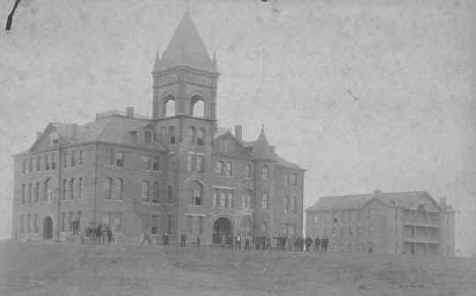
In the fall of 1891, the properties of the Searcy College on the
corner of Pine and Center Streets were sold and the school was relocated at the west end
of Race Street, now the twelve hundred block. The main building of the new college was
four stories in height and finished in pressed brick. At the first graduation exercise in
the lew location there were eighteen graduates, only two of whom were males. Academics
were not always on the boy's minds. Not long after Searcy College settled on the new
campus, they received approval of the following "official cheer:"
Hors, hors,
Gorunk, gorunk, gorn
Ha, Ho. hi. he!
Rah! Rah! Searcy!
The street running north to Race bespeaks the efforts of
Professor Tharp. since it is named appropriately, College Street. Tharp received
recognition outside of Searcy for his progressive ideas in education. He was president of
the Arkansas
Teacher's Association and the Arkansas Summer Normal School tor school teachers needing
additional training. He was also the managing editor of The Arkansas Educational Journal,
..A live and progressive monthly." 12'1 Professor
Tharp moved to Little Rock in 1892 and opened an academy bearing his name. In 1898, at the
commencement exercises of the Searcy College it was announced that the name of the school
was being changed to Speers-Langford Military Institute and would be under the direction
of Lieutenant Charles S. Fowler, with R. B. Willis and G. T. Storey as academic
principals. Funds for the institute had been supplied by Mrs. John R. Speers and Mr. and
Mrs. W. H. Langford of Pine Bluff. The name of the school honored the memory of Major John
R. Speers and young William Henry Langford, the husband and son respectively of the new
institute's benefactors.

The older Cadets of the Spears-Lankford Academy. Courtesy of Mrs. Lee Biggs
Several modifications were made in the two
buildings to facilitate the transition of the school from a predominantly female to an
all-male school with emphasis on military training and discipline. A new system of
electric lights arid a new waterworks were added in 1900 as well as cannon to give it a
fortIfied appearance. But tragedy struck the Institute twice within a year in the form of
fire. The dormitory was burned to the ground and students were forced to board in private
homes. The following year a fire destroyed the classroom building and students were left
without a place to continue their studies. Since the benefactors of the school were the
claimants to the insurance policies, they refused to allow the moneys to be used to
rebuild the buildings. The city of Searcy brought suit for the insurance, but since
attorney Stephen Brundidge, Jr.. was unable to locate the papers which allegedly obligated
the Speers and Langford families to perpetuate the school in such eventualities, the suit
was lost and the Institute ceased altogether.

A group of students from Speers-Langford Academy. Located on the North sie of
Arch Street.
Note: Dumbells in the hands of the cadets. Courtesy of Mrs. Lee Biggs
One attempt to establish a school in the late
nineteenth century apparently never made it off the ground. A warranty deed for the
property on which to locate a female school under the supervision of the Methodist
Church's Iacksonport District White River Conference was filed in the White County
courthouse June 2, 1873.131 The articles of incorporation for the proposed school were not
filed, however, for another two years. Israel Moore, I. B. Crane, Dandridge McRae and W.
B. Carter were the original board of trustees, but nothing is known of the school's
location or function. An article in the Arkansas Gazette, dated June 9, 1889, did note
that General Dandridge McRae, president of the board of trustees, presented a diploma to
the sole graduate, Miss Winnie Walker, and Bible Medal to Miss Laura Rumel. When the
Central Collegiate Institute was moved from Altus, Arkansas, in 1889, Searcy was among the
cities which bid to have the school located in their limits. Clarksville, Morrilton,
Stuttgart, Arkadelphia and Conway were also interested in having the school. After four
days and fifty one ballots, in which Searcy ran high, Conway was chosen and the school,
newly named Hendrix College, moved there.
|